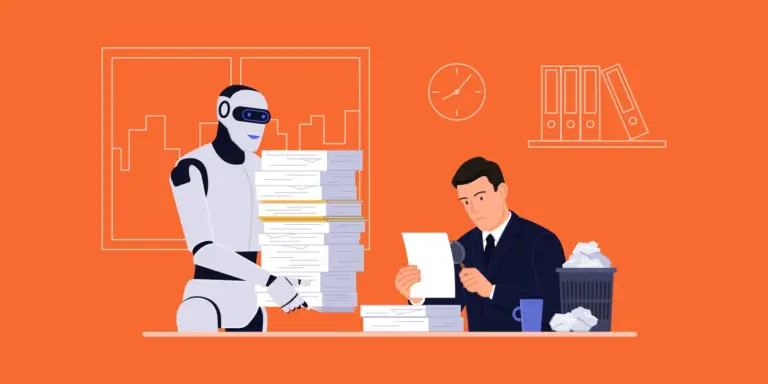
As AI floods organisations with instant analysis, auto-generated strategy decks and polished positioning frameworks, something else is happening quietly in parallel.
Businesses are realising they need more senior judgement, not less, as we risk facing a wave of ‘averageness’. At worst, it is a commoditisation of strategic decision making as leaders reach for the same LLM to solve their business problems.
Many things that were once expensive or time-consuming have become almost instantaneous. Data analysis is cheaper; research can be delivered faster and insight generation is increasingly automated. Using AI makes business sense and naysayers will get left behind.
But AI tools give businesses possibilities, not commitments and we risk creating a strategic gap at the top.
Who’s in charge?
When a company is going through major change, such as an acquisition or a new business model, decisions made carry enormous risk both financially, reputationally and operationally. These are pivotal moments in a business trajectory.
AI can contribute useful inputs at this stage. It can analyse market data, model scenarios, surface emerging patterns and generate a range of possible options. In many cases it can do this far faster and more comprehensively than traditional analysis can.
But strategy is not just about choosing an option that looks good in a dataset. It’s about who takes ownership when that decision collides with the unpredictability of markets, customers and competitors. Reality rarely follows a crystal-clear path, it’s often messy, complicated and uncomfortable.
AI can suggest paths forward, but it cannot help a leadership team live with the consequences of those choices. Ultimately, someone has to stand behind the strategy and take responsibility when things don’t unfold as planned. That responsibility still belongs to human leaders and their seat at the boardroom table relies on them taking account for how decisions play out.
AI expands what organisations are capable of analysing. But it also expands the responsibility placed on leadership to interpret those insights wisely.
Growing pains
This challenge becomes particularly visible in scale-up companies, where business leaders are often pulled in multiple directions. Much of their attention is directed outward toward capital growth and market positioning. Their time can be heavily focused on product development, raising funds and maintaining relationships with investors.
Meanwhile, internal teams are usually focused on execution. Operations teams are busy building systems that can support rapid growth. Finance teams are focused on forecasting, reporting and managing burn rates. Marketing is under pressure to produce lead-generating campaigns.
AI tools become incredibly attractive in this environment as they take the pressure off vital resource.
This is exactly the environment where AI tools are proving incredibly attractive. They promise efficiency gains, faster analysis and the ability to automate large portions of day-to-day work. Tasks that previously took hours or days can suddenly be completed in minutes.
For an ambitious scale-up trying to grow quickly while controlling costs, this sounds like the perfect solution. But, if AI tools are producing market analysis, competitor intelligence and performance insights automatically, is there an illusion that leadership work is already being done? Who is stepping back to ask the bigger questions like here is the company heading? What opportunities are we missing? Which risks are we underestimating?
In the past, senior executives often held an advantage because they had access to more information or better analysis. But when AI can generate reports, forecasts and recommendations in seconds, access to data is no longer the differentiator it once was.
The real value of leadership then lies in judgement, oversight and responsibility. Without strong human governance, organisations expose themselves to new kinds of risk.
More AI, more risk
Paradoxically, the more powerful AI becomes, the more important human governance becomes. EU Artificial Intelligence Act Regulatory frameworks are beginning to formalise expectations around AI oversight.
The EU Artificial Intelligence Act is the first comprehensive attempt to regulate artificial intelligence at scale. For businesses developing, deploying, or using AI, it signals a shift from largely voluntary best practices toward formal governance, accountability and regulatory oversight.
It introduces a risk-based regulatory model, with AI systems categorised according to the level of risk they pose to individuals and society. This means AI systems can no longer be treated purely as technical tools. Organisations using high-risk AI will need to implement formal governance processes, including human oversight of automated decisions.
The Act pushes AI oversight into the strategic governance sphere with senior leaders expected to think about AI in the same way they think about cybersecurity, financial compliance, or data protection. Leaders also play an important role in fostering ethical awareness, transparency and accountability in how AI is used.
It reinforces the idea that AI governance is not just a technical challenge but a leadership responsibility. Organisations that approach AI with strong human oversight and clear governance structures are better positioned to build trust with customers, regulators, and stakeholders while reducing operational and reputational risk.
C-Suite on demand
As organisations face growing pressure to adapt to rapid technological change and new regulations many are turning to the fractional C-suite model. These are senior leaders who work on a part-time, contract, or advisory basis rather than as a full-time employee.
The business challenges discussed in this article often require highly specialised leadership and many businesses may not need or be able to afford a full-time executive dedicated to each function.
These experts can lead on digital and AI transformation, guiding strategy, governance frameworks and mentor internal teams. They can bring to the table valuable experience from their work in other companies and provide a transformative leadership layer.
Fractional leaders will often have come from dynamic environments and are equipped to lead on agility during economic uncertainty and rapid technological change.
In areas like AI adoption, this kind of leadership support helps ensure that innovation happens responsibly and in alignment with regulatory and ethical standards.
Ultimately, the fractional C-suite allows organisations to access the level of leadership typically associated with larger enterprises. For scale-ups navigating rapid growth and volatile markets, C-suite on demand becomes a form of infrastructure, one which gives flexibility but without compromising on expertise.
Who wants to be average?
In a world where AI can generate everything from a five-year plan to a rebrand in minutes, the temptation is to mistake sophistication for strategy.
But strategy lives in conviction, accountability, governance, experience and sound judgment under pressure.
The rise of C-suite on demand therefore is no coincidence as more businesses recognise that they have a strategic gap. Whether a business takes on a fractional leader or not, organisations must take heed of the true capabilities of AI, maximise its strengths, but real competitive advantage is still human and begins and ends in the hands of our business leaders.