
As the calendar starts to fill up for this year, it hasn’t gone unnoticed to us just how many events our clients are committing to. Dial back a couple of years and we’d have seen blank entries, but there’s a shift back to almost a pre-pandemic uptake in getting ourselves and our businesses out there and mixing with our networks.
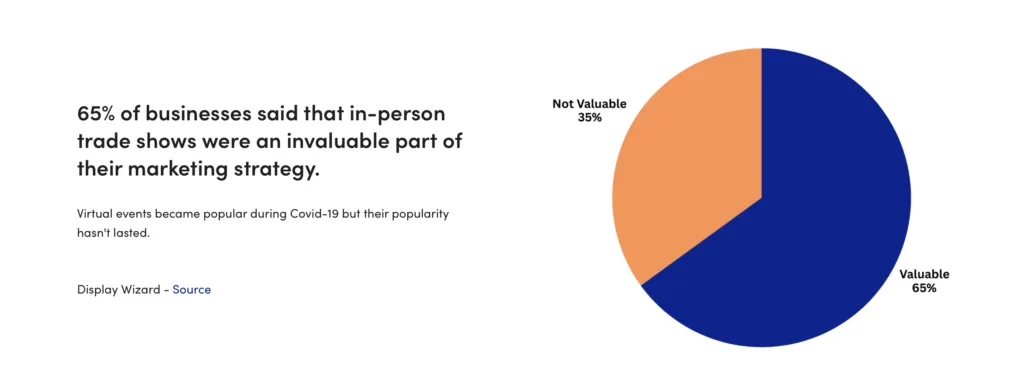
In fact, in a recent poll, 65% of businesses said that in-person trade shows were an invaluable part of their marketing strategy.
Smaller and regional
We’re also seeing more smaller events springing up – Gartner’s 2024 Magic Quadrant for Event Technology Platforms identifies the growth of smaller, regional events as a key trend shaping the market.
Global pandemics aside, events have long been a powerful channel for building brand awareness and loyalty. In a recent report, 77% of people trust brands more following face-to-face interactions at live events.
ROR not ROI
Part of the reason for a greater resurgence of face-to-face events is around how we can measure the value of an event. Evaluation scoring such as ROR (Return on Relationships) focuses on how you create value through building and nurturing relationships. ROR is ‘the value (both perceived and real) that will accrue over time through connection, trust, loyalty, recommendations and sharing.’
Of course, connection at an event is just one piece of the ROR puzzle and one of many metrics that indicate the value derived from customer relationships. Other examples are customer loyalty, repeat business, referrals, social media engagement etc.
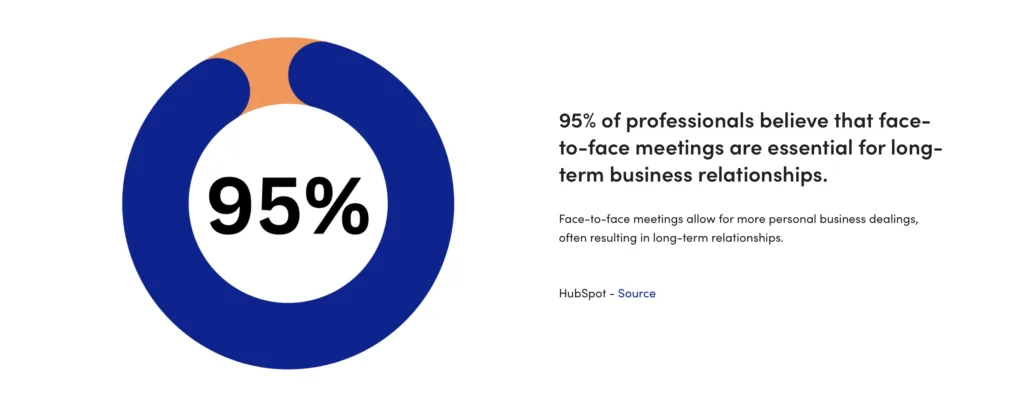
But eyeball to eyeball at an event can have a significant impact on ROR as it injects a personal element that can’t be replicated. People crave human connection and virtual connections just simply lack the energy and engagement of live events. Remembering that over 70% of communication is non-verbal, relying on body language, facial expressions, and tone of voice, these subtle cues convey emotions and intentions that words alone can miss.
Power of the simple stuff
There was a time (for a while anyway) when brands would choose to go to an event based on being noticeable by their absence rather than seeing real value in attending. Having now been through a global pandemic where people and businesses have been starved of physical interaction, we’ve realised the power of the simple stuff that got us talking in the first place.

From a purely practical and tactical perspective, trade shows offer networking dinners, product launches, and interactive experiences that digital events can’t replicate. They also give businesses the opportunity to learn about emerging trends and give you a chance to snoop on and analyse competitors.
But more than anything, they give us an opportunity to connect and in a way that doesn’t feel against the clock. They get us out of our office environment and out of our house for those that are hybrid working. They can also be a great career motivator as we see our industry ‘under one roof’. They can remind us of the power of the collective, namely the industry or sectors in which we work.
We won’t be stopping going to trade events any time soon and hope to see many of you there to have a good, old conversation. And if you’re thinking about whether to attend in person or virtually, we’ve got some thoughts on that too — read Show Up or Log In: How In-Person Tech Events Still Matter.